
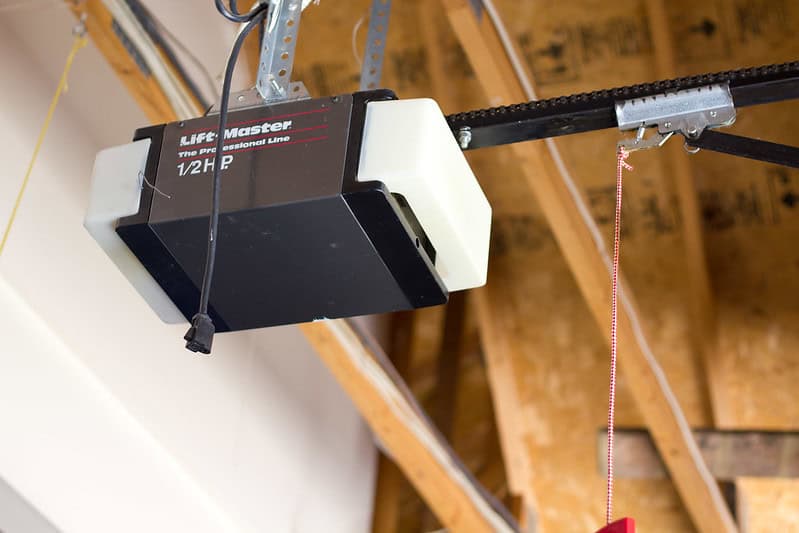
That red cord hanging from your garage door track gives you manual control when the automatic opener can’t do the job. Learning how to release and reset the emergency cord on a garage door is a useful skill for any homeowner, but it comes with real risks if the door isn’t balanced correctly. If you run into trouble at any point, our team is ready to help; simply contact us and we’ll get you sorted out.
What Is the Emergency Release Cord on a Garage Door?
The emergency release cord, often called the garage door manual release, hangs from the opener track near the ceiling. It’s usually tied to a red handle, which is why so many homeowners search for “what is the red string on garage door” when they first notice it. Pulling this cord disconnects the door from the opener motor by shifting a trolley mechanism out of its connected position. Once disengaged, the door moves freely by hand, independent of the motor that normally drives it along the rail.
Why You Might Need to Use the Emergency Release Cord
Power outages are the most common reason people reach for the emergency garage door release. If the opener has no electricity, the cord is the only way to open or close the door without an outside power source. Mechanical opener failures, a jammed sensor, or a door that’s stuck partway are other situations where the manual release becomes necessary. Some homeowners also use it briefly during troubleshooting or maintenance, though we’d recommend leaving diagnostic work to a trained technician whenever possible.
Important Safety Risks to Know Before Pulling the Cord
A garage door is the largest moving object in most homes, and it’s held up by torsion or extension springs under significant tension. Always make sure the door is fully DOWN before disengaging the opener. If you pull the cord while the door is up and a spring has failed, the door can crash down suddenly and without warning, since the opener may be the only thing keeping it from falling.
The Consumer Product Safety Commission (CPSC) has documented dozens of child deaths from garage door entrapment, which led it to require automatic reversing mechanisms and other entrapment-protection features on garage door openers. These documented deaths and entrapment incidents show how quickly a routine task can turn dangerous when hardware is worn, springs are damaged, or the door is out of balance.
Keep hands, fingers, and loose clothing away from moving parts, and never force the cord if it resists. Resistance or unusual noises mean something isn’t right, and pulling harder can bend the release lever or break the latch entirely.
How to Release the Garage Door Manually
If you’ve confirmed the door is safe to work on, here’s how to release a garage door manually.
Step 1: Close the Door Completely
Lower the door all the way before touching the cord. Disengaging a door that’s partially open, especially with a broken spring, is what leads to sudden, dangerous drops, so don’t skip this.
Step 2: Pull the Cord to Disengage the Opener
With the door fully closed, pull the cord downward. You’ll typically hear a click as the trolley disconnects from the drive mechanism; on LiftMaster openers, the release handle moves to a diagonal position, confirming the disconnect (it returns to a straight position only when you reconnect). If the cord is out of easy reach, use a sturdy stepladder rather than stretching or standing on something unstable.
Step 3: Carefully Move the Door by Hand
Once disengaged, lift the door slowly and pay attention to how it feels. A properly balanced door should rise and stay in place with minimal effort. If it shoots upward or drops on its own, stop immediately. That points to an unbalanced door, a damaged spring, or a worn cable, and it’s not something to push through on your own.
How to Reset and Reconnect the Emergency Cord
Once you’re ready to restore automatic function, here’s how to reset garage door after pulling red cord.
Step 1: Fully Close the Door Before Reconnecting
Just as with disengaging, the door must be completely closed before you try to reconnect it. Make sure power to the opener is restored if the release was triggered by an outage.
Step 2: Pull the Cord Toward the Opener to Re-Engage
Pull the cord down and toward the opener itself, not straight down, to re-engage the lever. This motion compresses the spring lever back into its connected position. Many homeowners searching for how to reconnect garage door after pulling red cord miss this angled pull and end up with a cord that won’t catch.
Step 3: Test the Opener for Proper Function
You can either slide the door manually until you feel the trolley catch, or run the opener directly. A loud, distinct click usually confirms the trolley has reconnected. Test the door a few times using both the remote and the wall switch to confirm smooth, consistent movement in both directions.
Signs Something Is Wrong After Resetting the Cord
Sometimes the reconnection doesn’t go as planned, and it’s worth knowing what to watch for. A cord that hangs limp with no tension and won’t re-engage is one of the more common complaints we hear, often described as garage door won’t re-engage or garage door emergency release stuck. If the release feels stuck or needs a hard yank to move at all, stop. Forcing it can bend the lever or snap the latch.
Other warning signs include a door that suddenly feels much heavier than usual, which often points to lost spring support, or an opener that runs but doesn’t move the door at all. A burning smell, a hot motor housing, or repeated humming from the opener are electrical or mechanical red flags.
Unexpected reversals, a door that gets stuck open, or a loud bang during operation, which can indicate a snapped spring or cable, are all reasons to stop troubleshooting and call a professional. These are the kinds of issues we see often in homes we’ve serviced across Lake County and the wider Chicagoland area.
Why This Is a Job Best Left to a Professional
The release cord itself is simple enough for most homeowners to use safely when the door is properly balanced. A slightly frayed cable, an off-balance spring, or a bent track can leave a door unstable even when everything looks fine on the surface, and on the largest moving object in most homes, that hidden risk isn’t one worth gambling on.
Spring, cable, and track repairs require specialized tools and training, and they’re genuinely dangerous to attempt without experience. Investing in professional garage door repair is almost always less costly than dealing with an injury or a door that’s been damaged beyond simple repair.
Our technicians bring at least five years of industry experience to every job, and each one passes a background check, drug test, and physical before ever stepping onto a customer’s property. They arrive in uniform and can show photo ID on request, so you know exactly who’s working on your home.
Contact Overhead Garage Door for Safe, Reliable Repairs in Chicagoland
Who We Are
Overhead Garage Door, Inc. has spent decades serving Chicagoland and southeast Wisconsin, including Barrington, Lake Zurich, and communities throughout Lake, Cook, McHenry, DuPage, Kane, Will, Boone, Winnebago, Kendall, Kenosha, Milwaukee, Racine, and Walworth counties. We’re an authorized dealer for Clopay Building Products, Ideal Door, and LiftMaster Operators, and we back our work with an A+ Better Business Bureau rating, an Angi Super Service Award, and nearly 1,000 Angi reviews from homeowners across the region.
Get Help Now
If your emergency release cord won’t reconnect, your springs or cables look damaged, or your door simply isn’t behaving the way it should, don’t keep troubleshooting on your own. Reach out for professional garage door repair, or contact us directly at 888.459.3720. We offer same-day and 24/7 emergency service throughout Ingleside, IL and the greater Chicagoland area, so help is available whenever you need it.